

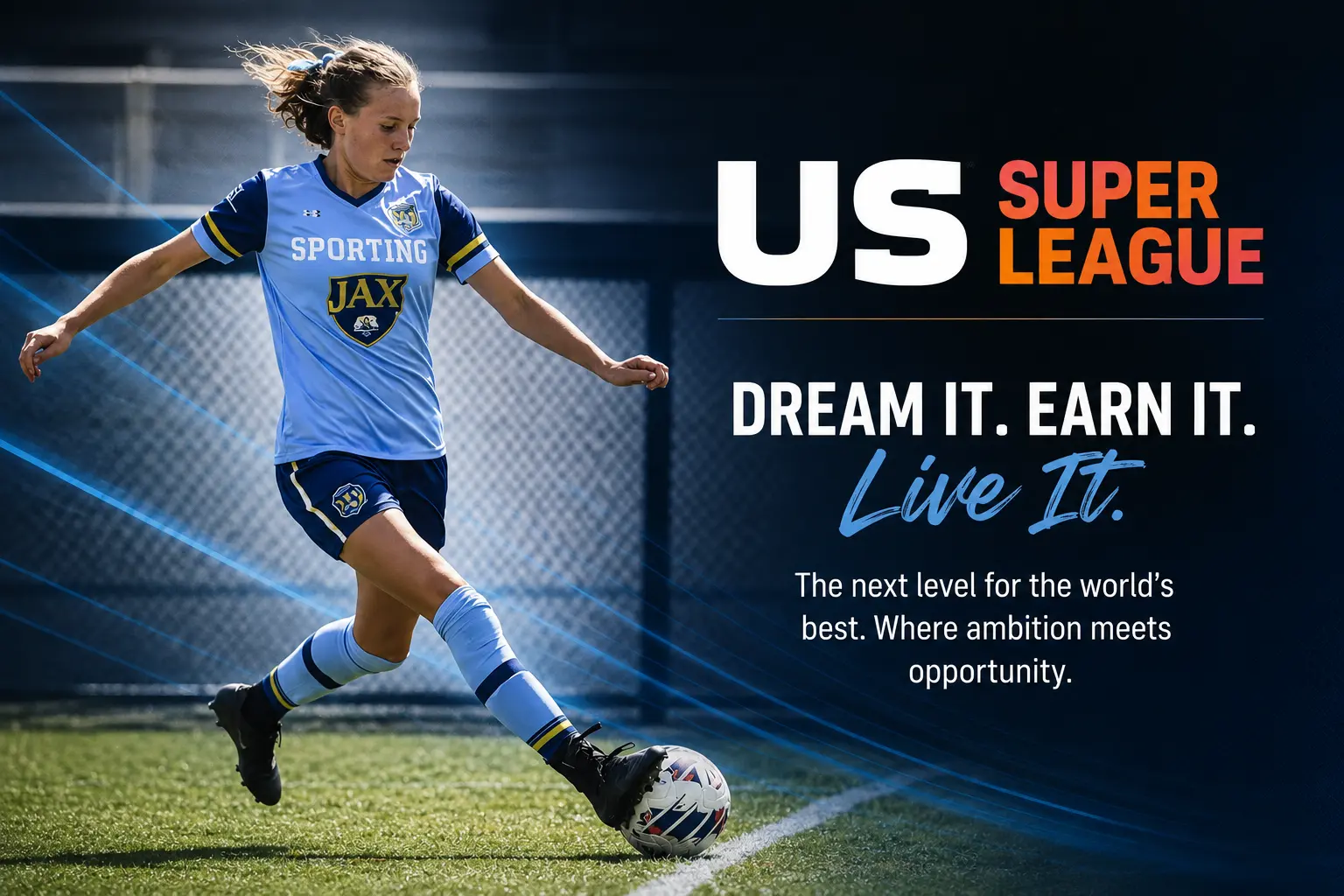
In the 90th minute of a Sporting JAX game against Fort Lauderdale United on December 13, 2025, I scored my first goal as a professional soccer player. Less than two years earlier, I was a senior at Johns Hopkins University — a Division III program with no athletic scholarships and almost no recent history of sending players to the pros. The D3 path to professional soccer isn’t supposed to exist, according to almost everything aspiring players are told. But it does. I’m Katie Sullivan, and this is the story of how I went from a Yardley, PA youth player to the USL Super League — and what I want every D3 athlete, and every family of one, to know about a route nobody talks about.
This isn’t a “how I made it” piece. It’s a breakdown of why the conventional wisdom is wrong, what actually changed, and what the modern path looks like for young players considering their options today.
What You’ll Learn
- The Myth: Why D3 Is Treated as a Dead End
- Why This Myth Exists — And What’s Changing
- The Path I Actually Took, Step by Step
- What This Means for Young Players Today
- How This Shapes My Coaching at KGoals
- Frequently Asked Questions
- Next Steps
The Myth: Why D3 Is Treated as a Dead End
Most young players grow up hearing the same hierarchy: D1 is the path to professional soccer, D2 is the fallback, and D3 is where you go if you want to play in college but can’t compete at higher levels. That ranking shapes recruiting calendars, scout coverage, and which players believe they belong on which tier. By the time a serious high school player is making her college decision, the message has been clear for years: if you want to go pro, you have to go D1.
The problem is that the message is, increasingly, just wrong. The professional women’s soccer landscape has changed dramatically in the last five years, and players from every level of college soccer are now finding pathways that used to be locked. But the myth is sticky. It keeps talented players away from schools that might be the right academic and athletic fit. It keeps families from considering options they should consider. And it keeps a lot of really strong D3 programs from getting the credit they deserve.
Why This Myth Exists — And What’s Changing
The D3-as-dead-end narrative isn’t random. It came from real, structural reasons — most of which are now shifting.
Less Scout Coverage at the D3 Level
Historically, pro scouts focused their time on D1 programs because that’s where the recruiting pipelines and showcase events were concentrated. A scout with limited time covers the highest-visibility games first. D3 players had to be discovered, not just observed.
No Athletic Scholarships Means Lower Visibility
D3 programs can’t offer athletic scholarships, which has shaped how recruiting works there. No big scholarship pitches, no major signing-day ceremonies, no recruiting-class rankings. That made it harder for elite high school players to find the right D3 programs and harder for D3 programs to find them.
The Old Pro Pipeline Was D1-Heavy
For decades, the NWSL draft pulled almost entirely from D1 programs. If you weren’t on a D1 roster, conventional wisdom said you weren’t going to be on a pro roster either. That assumption became self-fulfilling.
The “If You Were Good Enough” Story
This is the cultural part. Many people genuinely believe the best players sort themselves into D1 programs, so by definition D3 players must not be good enough for the next level. The reality is messier. Players choose D3 for academic fit, financial fit, geographic preference, family situations, late physical development, recruiting misses, or simply because they wanted to play at a school they loved. Talent doesn’t sort cleanly by division.
What’s Actually Changing
The growth of women’s professional soccer in the United States — including the launch of the USL Super League (officially the Gainbridge Super League) as a Division I professional league — has created more roster spots than the existing D1-only pipeline can fill. International leagues, including Ireland’s Women’s Premier Division (where I played with Athlone Town in 2025), are also becoming legitimate stepping stones. The pathways are multiplying. The myth is breaking.
The Path I Actually Took, Step by Step
So how does a kid from Yardley, Pennsylvania end up scoring for a professional team in Jacksonville? Not by accident, and not by a single big break. Here’s the real progression.
Youth Soccer in Bucks County
I came up through NJ Rush Grey and Yardley Makefield Soccer. Bucks County is a competitive soccer area, and I had access to strong coaching and strong competition from a young age. I also volunteered with YMS’s Special Stars program, coaching kids with special needs — which shaped how I think about the game more than it should have.
High School at Villa Joseph Marie
At Villa Joseph Marie, I scored 56 goals and recorded 44 assists, won four district titles, and was part of a PIAA Class 3A state championship team in 2018. I was a productive player. I was not a top-50 national recruit. Major-D1 recruiting attention wasn’t there the way it was for some peers.
Choosing Johns Hopkins
When I made my college decision, I chose Johns Hopkins over higher-division options. The academics mattered. The coaching staff mattered. The fit mattered. At the time, I told myself I might be giving up some soccer ceiling for a better overall experience. I turned out to be wrong about that.
Four Years at Hopkins
Across four seasons (2021–2024), I scored 60 goals and recorded 31 assists, finishing second in program history in goals, assists, and points. I was a four-time All-American — the first in Johns Hopkins women’s soccer history — and won D3 National Player of the Year as a senior, the first in both Johns Hopkins and Centennial Conference history. The team won the NCAA Division III National Championship in 2022, where I scored the game-winning goal in the final against Case Western Reserve. I was a Honda Athlete of the Year Finalist. None of that happens at D1. None of it would have happened to me at D1. The D3 environment — coaching, playing time, role on the team — was what made me into the player I became.
Going Overseas: Athlone Town
After graduating in 2024, I signed with Athlone Town AFC in Ireland’s Women’s Premier Division for spring 2025. Three goals, three assists, real first-team minutes against professional competition. Going overseas was about earning professional reps and proving I could compete at that level.
Sporting JAX
On June 18, 2025, Sporting JAX signed me in the USL Super League. The team finished the first half of the season in first place. I scored my first professional goal in December 2025 — that 90th-minute equalizer against Fort Lauderdale United — and a game-winner against Tampa Bay Sun FC a week later.
What This Means for Young Players Today
If you’re a young player, or the parent of one, here’s what I want you to take from this:
You don’t have to choose between academics and soccer ambition. You don’t have to chase a D1 offer at a program that’s a bad fit just because someone told you that’s the only way to go pro. The path to professional soccer isn’t one road anymore — it’s several. The right college fit (academically, socially, athletically) matters more than the division written on the program’s name.
That doesn’t mean D3 is the right path for every player. D1 is the right call for many. But if D3 makes more sense for your life, don’t let anyone tell you it closes the door on going pro. It doesn’t.
How This Shapes My Coaching at KGoals
KGoals exists because of this story, not in spite of it. I built it to give young players in Bucks County and beyond the kind of training and perspective I would have wanted growing up: coaching from someone actively playing at the professional level, real talk about what college soccer actually looks like at every division, and individual attention to development. Why training with a current professional player matters covers more on the coaching side of this work, and the full story of my journey is up on the blog if you want the deeper version.
Frequently Asked Questions
Can D3 soccer players really go pro? Yes. The professional women’s soccer landscape has expanded significantly with the launch of the USL Super League and continued growth of the NWSL, and players from every college division are finding professional pathways. The idea that only D1 players can go pro is outdated.
What’s the difference between D1, D2, and D3 soccer? D1 programs offer athletic scholarships and the largest recruiting visibility. D2 programs offer partial athletic scholarships. D3 programs offer no athletic scholarships but often strong academics and a different playing environment. All three produce professional players today.
How did Katie Sullivan get signed to a professional team? After winning D3 National Player of the Year at Johns Hopkins in 2024, I signed with Athlone Town AFC in Ireland for spring 2025, then joined Sporting JAX in the USL Super League in June 2025. The path included strong college performance, national awards, and overseas professional reps.
What is the USL Super League? The USL Super League — officially the Gainbridge Super League — is a Division I professional women’s soccer league in the United States. Sporting JAX is one of the league’s founding clubs.
Is D3 soccer competitive? Very. Top D3 programs train at a high level, recruit nationally, and play in highly competitive conferences. Johns Hopkins competes in the Centennial Conference and has produced a four-time All-American and a National Player of the Year in recent years.
Should I choose D3 over D1 if I want to play pro? That depends on academic fit, playing opportunity, coaching environment, and personal goals — not on which division has more status. Many D3 programs offer a stronger development environment than lower-tier D1 programs, especially for players who want to balance academics and athletics seriously.
How do D3 players get scouted by pro teams? Strong college performance, national awards, NCAA tournament play, and exposure through showcases and overseas leagues all contribute. Many D3 players who reach the pros play internationally first or earn visibility through national-level recognition before signing domestically.
Where can I follow Katie Sullivan’s professional career? Follow @_ksullivann on Instagram or connect on LinkedIn at linkedin.com/in/katiesullivan1227. KGoals.net has updates on Katie’s professional career, speaking engagements, and youth training programs.
Next Steps
If this story matters to you — whether you’re a young player, a parent of one, or a brand or organization interested in working together — here’s how to connect:
- Follow the journey: Instagram (@_ksullivann), LinkedIn, and KGoals.net
- Book Katie for speaking engagements at clubs, schools, or events through the Book Katie page
- Inquire about youth training in Bucks County and surrounding areas
- Brand partnerships and sponsorship inquiries: reach out via KGoals.net
About the Author
Katie Sullivan is the founder of KGoals and a professional soccer player currently competing for Sporting JAX in the USL Super League. A Yardley, PA native and Villa Joseph Marie graduate, Katie is the D3 National Player of the Year, a 4x All-American (first in Johns Hopkins history), Honda Athlete of the Year Finalist, and NCAA Division III National Champion. She holds an economics degree from Johns Hopkins University and has been volunteering with youth through Special Stars and AHTN Shared Meals since 2017.