

You signed your kid up for soccer camp last summer. They had fun, came home tired, maybe learned a few new moves. But when fall season started, you noticed something: they weren’t really any better. Same hesitation on the ball. Same weak foot they refuse to use. Same habits they’ve had for two years.
Sound familiar?
I hear this from Bucks County parents all the time. They’ve spent hundreds — sometimes thousands — on camps and clinics, and their kid is still stuck in the same place. It’s frustrating. And it’s not their fault.
The problem isn’t the kids. It’s what most youth soccer training is actually giving them.
I’m Katie Sullivan. I grew up playing soccer in Yardley, went to Johns Hopkins, and now I play professionally for Sporting JAX in the USL Super League. I’ve seen youth soccer from every angle — as a kid going through the system here in Bucks County, as a college player, and now as a pro. And I can tell you exactly why most camps don’t produce the results parents expect.
What You’ll Learn
- Why Most Soccer Camps Don’t Produce Real Improvement
- The Real Causes Behind the Problem
- How to Tell If Your Child’s Training Is Actually Working
- What Makes Training with a Professional Different
- Why Bucks County Parents Choose KGoals
- Frequently Asked Questions
- Next Steps
Why Most Soccer Camps Don’t Produce Real Improvement
Here’s the uncomfortable truth: most youth soccer camps are designed to keep kids busy and happy, not to make them significantly better players.
That’s not a knock on the people running them. Many are well-intentioned coaches who genuinely care about kids. But the structure of most camps works against real development.
Think about what happens at a typical summer camp. Your child shows up with 30 or 40 other kids. They run through the same drills everyone else runs through. They scrimmage. They get a snack. They go home.
The coach might be a former college player. Maybe they played D2 or D3 ten years ago. Maybe they’re a high school coach who runs camps in the summer for extra income. They know soccer. But they’re not doing it at the highest level right now. They’re teaching what they remember, not what’s actually working in professional environments today.
And even if they wanted to give your child individual attention, they can’t. Not with a 15-to-1 or 20-to-1 player-to-coach ratio.
So your kid has fun, gets some exercise, and comes back next year at roughly the same level. The camp did its job — it just wasn’t the job you thought you were paying for.
The Real Causes Behind the Problem
When I talk to parents about why their kids aren’t improving, it usually comes down to three things:
Generic Curriculum, Not Individualized Development
Most camps run the same drills for every player regardless of age, position, or skill level. A 9-year-old beginner and a 14-year-old travel player might be doing the same passing exercise.
That’s not how development works. A kid who’s been playing for six years needs completely different challenges than a kid who just started. When everyone does the same thing, the beginners get overwhelmed and the advanced players get bored. Nobody improves as much as they could.
Coaches Who Aren’t Playing at a High Level Anymore
This is the big one. Most youth coaches stopped playing competitive soccer years ago. They’re teaching from memory, not from current experience.
Soccer evolves. The way I was coached at YMS in 2012 is different from how I was coached at Johns Hopkins in 2022, which is different from what I’m learning now as a pro. Tactics change. Training methods improve. What worked a decade ago might be outdated today.
When your child trains with someone who’s actively playing at a high level, they’re getting current information — what’s actually working right now, not what used to work.
No Real Feedback Loop
At a big camp, your child might get a “good job” or a quick correction during a drill. But they’re not getting detailed, specific feedback on their game. Nobody is watching them closely enough to say, “Here’s exactly what’s holding you back, and here’s how we’re going to fix it.”
Without that feedback, kids repeat the same mistakes. They reinforce bad habits instead of building good ones. And parents have no idea what their child should actually be working on at home.
How to Tell If Your Child’s Training Is Actually Working
Here are some signs that your current approach might not be producing the results you’re paying for:
- Your child has attended multiple camps but still struggles with the same fundamental skills
- They avoid using their weak foot almost entirely
- They hesitate in 1v1 situations instead of taking players on
- They don’t seem to understand positioning or spacing during games
- They can do drills in practice but can’t execute the same skills in game situations
- They’ve lost enthusiasm for the sport or seem frustrated with their progress
If any of these sound familiar, it’s not your child’s fault. They probably just need a different approach — more individual attention, more specific feedback, and coaching from someone who’s actually doing it at the highest level.
What Makes Training with a Professional Different
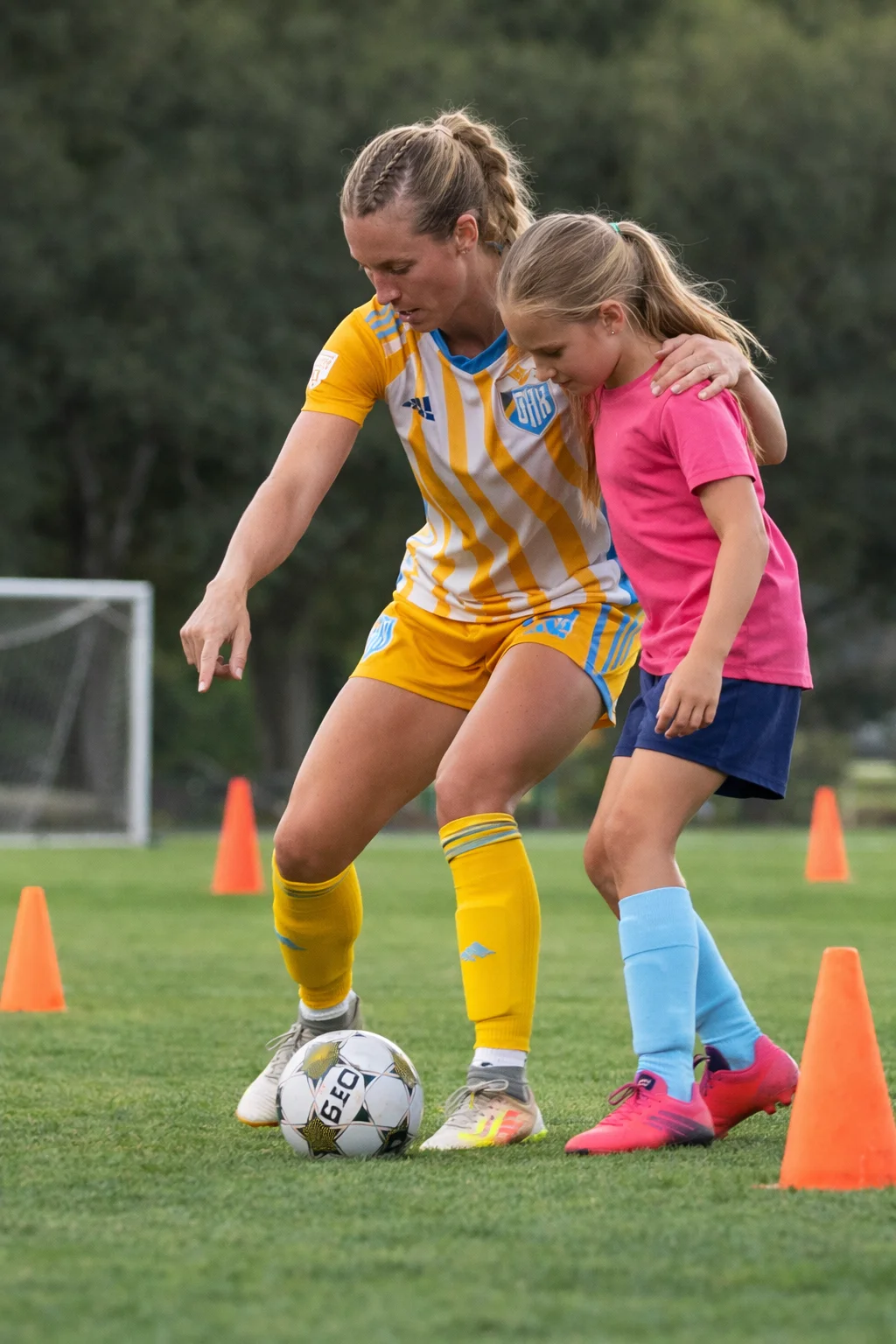
When I work with young players, I bring something most coaches can’t: I’m still playing. Every week, I’m training at a professional level, competing against top players, and learning from coaches who work with the best in the game.
That means I can show your kid exactly what’s expected at higher levels — not what I remember from ten years ago, but what I’m literally doing right now.
Here’s what that looks like in practice:
Current, Relevant Instruction. The techniques I teach are the same ones I’m using in professional matches. When I show a player how to receive under pressure or create space off the dribble, it’s because I did that exact thing in a game last week.
Real Feedback, Not Generic Encouragement. I watch how each player moves, how they strike the ball, how they make decisions. Then I tell them specifically what to work on. Not “good job” — actual feedback they can use.
Smaller Groups, More Attention. I keep my training sessions small because I know that’s how real development happens. Your child isn’t going to get lost in a crowd of 40 kids.
Perspective on the Path. I took the D3 route to professional soccer. I know what it takes to develop without being in a big-name program. I can help players and parents understand what actually matters for long-term development — and what’s just noise.
Why Bucks County Parents Choose KGoals
I grew up here. I played at YMS. I went to Villa Joseph Marie. I know the Bucks County soccer landscape because I came up through it.
That means I understand what local players are dealing with — the travel team culture, the pressure to specialize early, the tournament circuit that eats up weekends. I also know the strengths of this community. There are a lot of talented kids here who just need the right guidance.
KGoals isn’t about running another generic camp. It’s about giving Bucks County families access to professional-level training that actually produces results. I’m the only current pro player offering youth training in this area. That’s not marketing — it’s just a fact.
If you want your child to train with someone who’s been where they want to go and is still actively competing at the highest level, that’s what I’m offering.
Frequently Asked Questions
How is training with a pro different from a regular soccer camp?
Regular camps typically have large groups, generic drills, and coaches who stopped playing competitively years ago. Training with a current professional means smaller groups, individualized feedback, and instruction based on what’s actually working at the highest level right now.
What ages do you work with at KGoals?
I work with players ages 6-18. The training is adjusted based on age and skill level — what I do with a 7-year-old beginner is completely different from what I do with a 15-year-old travel player.
How much does professional soccer training cost in Bucks County?
Pricing varies depending on the program — camps, clinics, and private training are all priced differently. Visit KGoals.net for current pricing, or reach out through the contact page for details.
My child is a beginner. Is this too advanced for them?
Not at all. I meet every player where they are. Beginners focus on fundamentals and building confidence. Advanced players work on higher-level skills and game IQ. Everyone gets coaching appropriate to their level.
Do you only train girls, or boys too?
Both. I work with boys and girls of all ages and skill levels.
What areas do you serve?
I’m based in Yardley and serve all of Bucks County, including Newtown, Langhorne, Morrisville, and Lower Makefield. I also work with families from Montgomery County, PA and Mercer County, NJ.
How do I know if my child needs private training vs. a camp?
Camps are great for general skill-building and meeting other players. Private or small-group training is better if your child needs focused attention on specific weaknesses or wants accelerated development. I’m happy to help you figure out what makes sense — just reach out.
Can my child really improve from just a few sessions?
Yes, if the sessions are focused and they practice what they learn. I give every player specific things to work on at home. The kids who improve fastest are the ones who put in time between sessions.
Next Steps
If you’re tired of paying for camps that don’t produce results, here’s what I’d suggest:
- Check out KGoals.net to see what programs are available this season
- Reach out through the contact page if you have questions about what’s right for your child
- Follow me on Instagram (@_ksullivann) for training tips and updates
I can’t promise your child will go pro. But I can promise they’ll get real coaching from someone who’s actually doing it at the highest level — and that’s more than most camps can say.