

Your child went to a week of soccer camp last summer. They came home tired, happy, and maybe a little sunburned. But when fall season started, you noticed something: not much had actually changed. Same first touch. Same hesitation in the box. Same habits. The camp was fun — but was it development? If you’re a Bucks County parent who’s asked this question, you’re not imagining things. The format of the training matters as much as the coaching, and large camp sessions have a structural ceiling that most parents never hear about until they’ve already paid for three weeks of it.
I’m Katie Sullivan, founder of KGoals and a current professional player with Sporting JAX in the USL Super League. As a D3 National Player of the Year and four-time All-American, I’ve trained in every format — large camps, small groups, private sessions, and team environments from YMS in Yardley through the professional level. Here’s what I’ve learned about why small group soccer training consistently produces more improvement than large camp sessions, and what that means for Bucks County families making training decisions.
What You’ll Learn
- The Real Problem with Large Camp Sessions
- Why the Format Creates the Ceiling
- What Small Group Training Actually Looks Like
- When Large Camps Still Make Sense
- Why Bucks County Parents Choose KGoals
- Frequently Asked Questions
- Next Steps
The Real Problem with Large Camp Sessions
Large camps aren’t bad. Many of them are well-organized, fun, and staffed by decent coaches. The problem is structural: when you put 25 or 30 kids on a field with two or three coaches, certain things become mathematically impossible.
Individual feedback disappears. A coach managing 15 players in a drill can’t stop and correct each one. Your child might execute a technique incorrectly for an entire session — an entire week — and never hear a single correction. They’re getting reps, but they’re getting reps of the wrong thing.
Touches on the ball drop dramatically. In a large group, players spend more time standing in line waiting for their turn than actually training. Research on youth sports development consistently shows that the number of quality touches per session is the single best predictor of technical improvement. When group size doubles, touches per player don’t just decrease a little — they drop by half or more.
Differentiation becomes impossible. In a group of 30, players range from beginners to advanced. The coach has to pick a middle lane, which means half the group isn’t being challenged enough and the other half is overwhelmed. Neither group is training at the level that would actually produce growth.
Why the Format Creates the Ceiling
Understanding why large groups limit development helps parents make better decisions. It comes down to four factors.
The Feedback Loop Is Broken
Skill development depends on a feedback loop: attempt, observe, correct, repeat. In a small group, a coach can watch a player’s technique, identify the error, explain the fix, and watch the next attempt — all within seconds. In a large camp, that loop stretches into minutes or disappears entirely. The player keeps repeating the error because no one caught it. Over a full week of camp, a child can cement a bad habit so deeply that fixing it later takes twice as long as it would have taken to correct it in real time.
Drill Design Has to Go Generic
Good coaching meets the player where they are. A strong 11-year-old midfielder needs different work than a developing 11-year-old goalkeeper. In a small group of four to eight players, a coach can tailor drills to the actual skill level and position of every player in the session. In a large camp, the drills have to work for everyone, which means they’re optimized for no one.
The Social Dynamic Changes
In large groups, kids naturally sort themselves. The confident players dominate. The quieter ones hang back. The ones who need the most development often get the least attention because they don’t demand it. In my experience working with players of all backgrounds — including through the Special Stars program at YMS — the players who benefit most from quality coaching are often the ones who get the least of it in a large camp environment.
Time Gets Eaten by Logistics
Water breaks, bathroom lines, equipment distribution, group transitions, team talks. In a 30-player camp session that’s scheduled for 90 minutes, actual training time is often closer to 55 or 60 minutes. In a small group session, logistics take two or three minutes. Almost every minute is spent training.
What Small Group Training Actually Looks Like
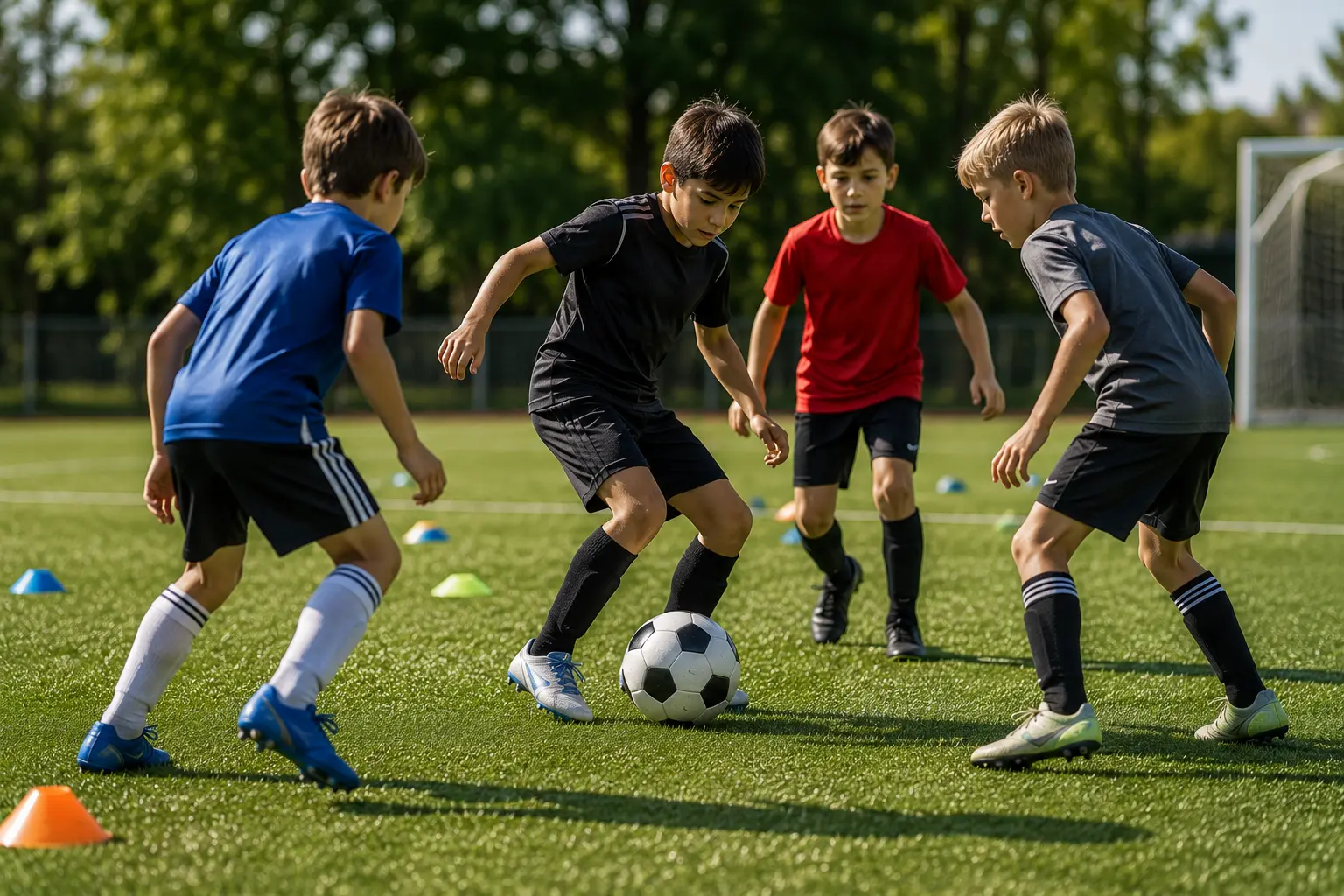
Small group training — typically four to eight players with one qualified coach — solves every structural problem above. Here’s what changes.
Every Player Gets Seen
With four to eight players, a coach can observe and correct every single rep. Your child doesn’t just do the drill — they do the drill, get specific feedback, and do it again with the adjustment. That feedback loop is what turns practice into real development.
The Work Matches the Player
In a small group, the coach can adjust difficulty, intensity, and focus based on who’s in the session. A group of competitive travel players gets different work than a group of recreational beginners. A session focused on finishing looks different from a session focused on defensive positioning. The training matches the player, not the other way around.
Touches Per Player Go Up Dramatically
In a small group of six, each player gets roughly five times more touches than they would in a group of 30 doing the same drill. More quality touches per session means faster technical development. It’s simple math, and it’s the single biggest reason small groups produce faster improvement.
Accountability Is Built In
In a small group, there’s nowhere to hide. Every player is engaged, every rep matters, and every player knows the coach is watching. That accountability pushes players to focus in a way that large groups simply can’t replicate.
For parents evaluating different training formats this summer, our summer soccer camp checklist includes specific questions about player-to-coach ratios that help you compare programs in Bucks County.
When Large Camps Still Make Sense
Small group training isn’t a replacement for everything. Large camps have real value in the right context.
For first-time campers, large camps provide social exposure, team dynamics, and a low-pressure introduction to organized soccer. If your child has never been to camp, a week in a larger group is a great way to test their interest and meet other players. Our guide to what to expect at your child’s first soccer camp covers how to prepare for that experience.
For players who already have a technical foundation, large camps can be useful for scrimmage experience, learning to compete in a crowd, and building resilience. The key is knowing what you’re paying for. If the goal is socialization and game exposure, a large camp delivers. If the goal is measurable skill improvement, the format is working against you.
The strongest summer development plan for most Bucks County players is a combination: one or two weeks of camp for the social and competitive experience, plus regular small group or private sessions throughout the summer for the technical development that camps can’t provide. Our guide on how to help your child improve at soccer this summer walks through how to build that balance.
Why Bucks County Parents Choose KGoals
I built KGoals around small group training for exactly the reasons this post describes. Every session maintains a low player-to-coach ratio because that’s the only way to deliver the kind of individual feedback that produces real, measurable improvement. I’m a current professional player with Sporting JAX, a D3 National Player of the Year, a four-time All-American, and a Yardley native who grew up in the Bucks County soccer system — and I’m on the field coaching, not handing a clipboard to a teenager.
If you’re comparing training options and want to understand why working with a current professional player matters, that breakdown covers what separates professional-level coaching from the alternatives.
Frequently Asked Questions
What is small group soccer training? Small group soccer training is a structured session with typically four to eight players and one qualified coach. The low ratio allows for individualized feedback, position-specific drills, and significantly more touches per player than large camp formats.
How many players should be in a small group soccer session? The ideal range is four to eight. Below four, you lose some of the competitive and game-realistic dynamics. Above eight, individual feedback starts to decline and you begin approaching the structural limitations of a large group.
Is small group training better than private one-on-one sessions? Both have value. Private sessions are best for targeted technical work and correcting specific habits. Small groups add a competitive element, decision-making under pressure, and game-realistic scenarios that one-on-one sessions can’t replicate. Most players benefit from a mix of both.
How much does small group soccer training cost in Bucks County? Small group sessions in Bucks County typically range from $40 to $80 per player per session, depending on coach credentials, group size, and session length. Sessions with a current professional player are typically toward the higher end of that range.
How often should my child do small group training? For most youth players, one to two small group sessions per week — in addition to regular team practice — is the sweet spot for consistent improvement without overtraining. During the summer, this can increase slightly if balanced with rest days.
What ages benefit most from small group soccer training? Players ages 8 and up benefit most. Younger children (5–7) often do better in slightly larger, play-based formats where the emphasis is on fun and movement rather than technical correction. By age 8 or 9, most players are ready for the focused feedback that small groups provide.
Can small group training replace regular team practice? No — and it shouldn’t. Team practice develops tactical understanding, communication, and game-situation awareness that individual and small group training can’t replicate. Small group training supplements team practice by addressing the technical and position-specific development that team environments don’t have time for.
Where does KGoals offer small group training in Bucks County? KGoals serves Yardley, Newtown, Langhorne, Morrisville, Levittown, Lower Makefield, and surrounding Bucks County areas, plus Montgomery County, PA and Mercer County, NJ.
Next Steps
Here’s how to start making the format work for your child:
- Ask the ratio question. Before registering for any program, ask how many players per coach will be on the field. The answer tells you more than any marketing copy.
- Match the format to the goal. Social experience and game exposure? Camp works. Measurable skill improvement? Small groups win.
- Reach out for a conversation. I’m happy to help you figure out the right training mix — whether that includes KGoals or not.
KGoals serves families across Bucks County, Montgomery County, PA, Mercer County, NJ, and the greater Philadelphia area. Visit KGoals.net or send a DM on Instagram (@_ksullivann) to start the conversation.
About the Author
Katie Sullivan is the founder of KGoals and a professional soccer player currently competing for Sporting JAX in the USL Super League. A Yardley, PA native and Villa Joseph Marie graduate, Katie is the D3 National Player of the Year, a 4x All-American (first in Johns Hopkins history), Honda Athlete of the Year Finalist, and NCAA Division III National Champion. She holds an economics degree from Johns Hopkins University and has been volunteering with youth through Special Stars and AHTN Shared Meals since 2017.